Commercial Edge Protection Compliance: What's Required on Australian Construction Sites
Falls from height remain the leading cause of workplace fatalities in Australia's construction sector. According to Safe Work Australia, falls consistently account for the largest share of worker deaths on construction sites year after year, and the majority of those falls are preventable with compliant edge protection.
For commercial builders, project managers, and safety officers, understanding exactly what the law requires is not optional. Getting it wrong exposes your organization to project shutdowns, WorkSafe improvement notices, six-figure penalties, and most critically the risk of serious injury or death on your site.
This guide explains the specific legal requirements for commercial edge protection compliance in Australia: which regulations apply, what height thresholds trigger mandatory controls, which Australian Standards govern system performance, who is responsible, and how the rules vary by state. Whether you are managing a multi-storey commercial build in Sydney or overseeing a warehouse fit out in Perth, this is the compliance reference you need.
What Is Edge Protection in Commercial Construction?
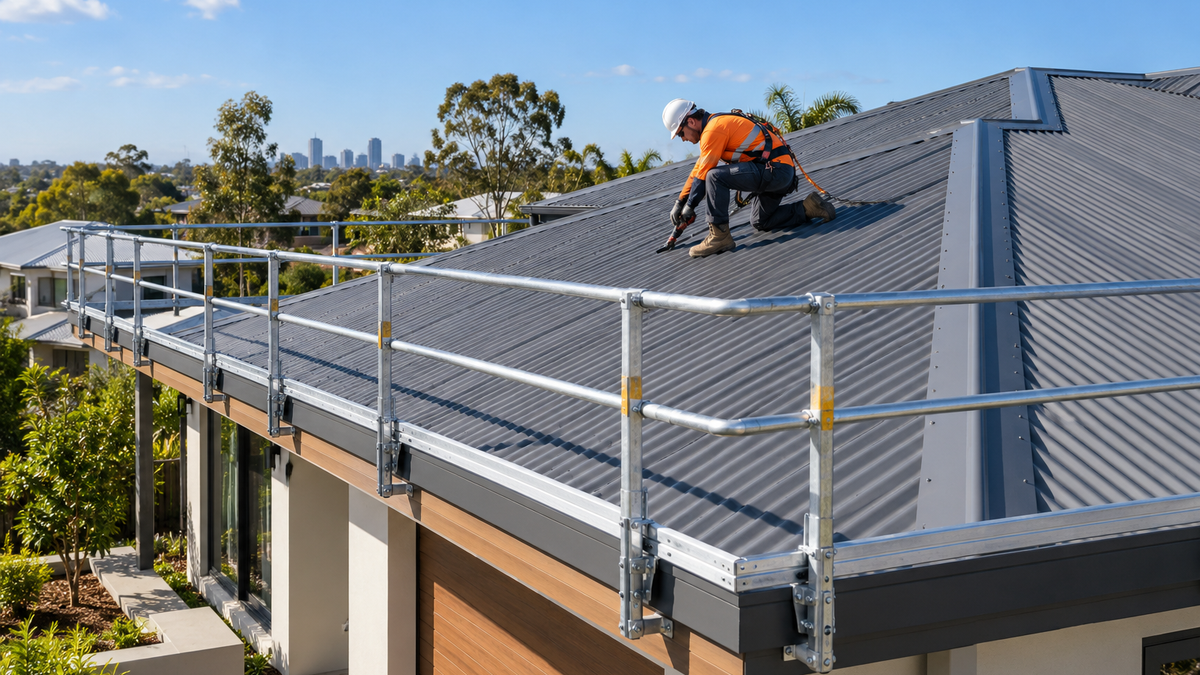
Edge protection is a physical barrier system installed along the perimeter of an elevated work surface to prevent workers from falling. On commercial construction sites in Australia, this typically takes the form of guardrail systems, scaffolding, or temporary perimeter barriers installed along roof edges, floor openings, elevated platforms, and stairwells.
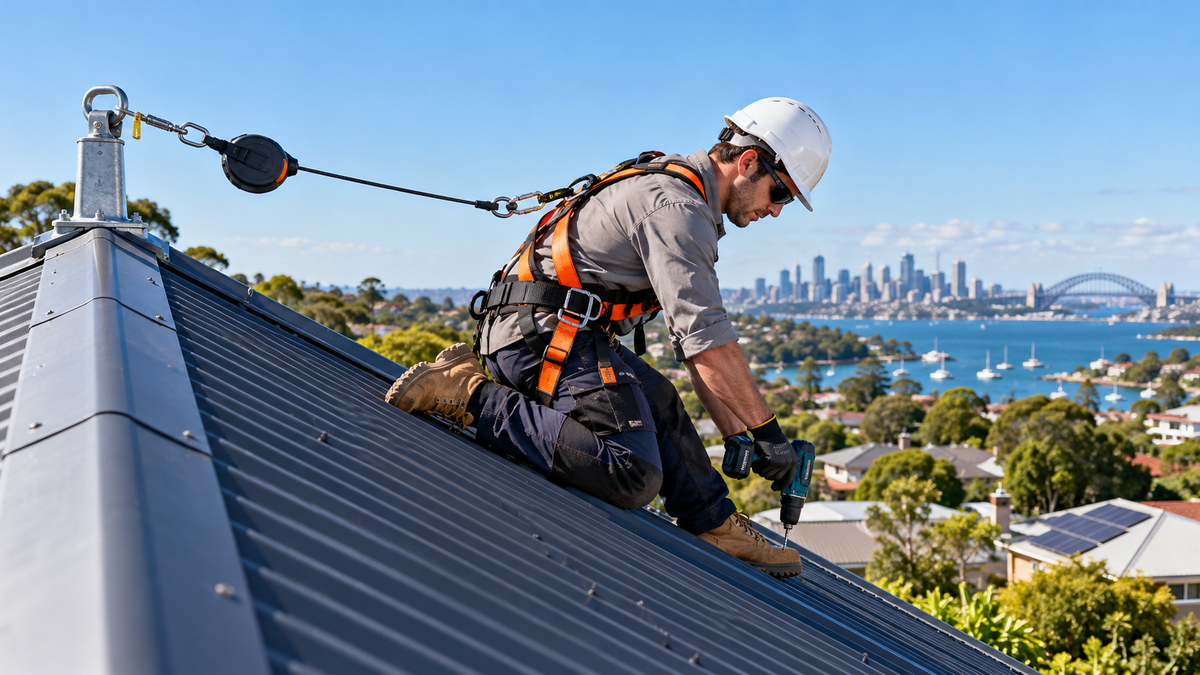
Edge protection is a preventive control it stops a fall from occurring in the first place. This distinguishes it from fall arrest systems such as safety harnesses and safety nets, which are reactive controls designed to minimise the consequences of a fall after it begins. Under Australian WHS legislation, preventive controls are always preferred over reactive ones.
On commercial construction sites, edge protection is required across a wide range of scenarios:
- Roof perimeters including flat, low-pitch, and high-pitch commercial roofs
- Floor and wall openings lift shafts, service penetrations, stairwells
- Elevated work platforms and mezzanine levels
- Excavations and trenches where adjacent work creates fall risk
- Loading dock edges and hoist zones
Commercial sites present unique challenges compared to residential construction. Multiple trades work simultaneously, creating more workers exposed to the same edges at the same time. Penetrations and service openings are far more common in commercial floors and are a frequently overlooked compliance gap. Edge protection systems on commercial sites must account for all exposed workers not just the crew performing roof work at any given moment.
The Australian Regulatory Framework for Edge Protection
A three-layer framework governs commercial edge protection compliance in Australia. Understanding how these layers interact is essential for any duty holder.
Layer 1: WHS Act (Federal and State): The Work Health and Safety Act (adopted in most states and territories) establishes the overarching duty of care. The PCBU must eliminate or minimise risks to health and safety so far as is reasonably practicable.
Layer 2: Model WHS Regulations: These regulations sit beneath the Act and impose specific obligations. Regulation 36 directly governs the management of fall risks and specifies when physical controls, including edge protection, are legally required.
Layer 3: Australian Standards: AS/NZS 4994.1:2023, Temporary edge protection, Part1: Systems for roof and floor edges is the primary Australian Standard for residential and commercial temporary edge protection systems. All compliant products should carry documentation confirming testing against this standard.
Safe Work Australia is the national policy body responsible for the Model WHS Act and Regulations. Each state and territory has its own regulator that enforces compliance on the ground.
Model WHS Regulations: What They Require
- Identify all fall risks
- Eliminate those risks so far as is reasonably practicable
- Where elimination is not reasonably practicable, minimise the risk by implementing the hierarchy of controls in order: substitution, isolation, engineering controls, administrative controls, and finally personal protective equipment (PPE)
Edge protection is an engineering control; it sits third in the hierarchy. This means that before installing edge protection, duty holders must genuinely consider whether the fall risk can be eliminated (for example, by redesigning the task so work at height is not required) or substituted. In practice on active commercial construction sites, elimination is rarely achievable, and compliant edge protection becomes the primary required control.
Safe Work Australia's Code of Practice: Managing the Risk of Falls at Workplaces is the primary guidance document for applying these regulations. It is freely available at safeworkaustralia.gov.au.
At What Height Is Edge Protection Required on Commercial Construction Sites?
Key Requirement: Under the Model WHS Regulations, fall risks must be managed when work is performed at 2 metres or more above the ground or a lower level. This is the primary height threshold that triggers mandatory edge-protection obligations on commercial construction sites in most Australian jurisdictions.
The 2-metre threshold is the most critical number in Australian edge protection compliance. However, this threshold applies to the requirement to manage fall risk, and, on commercial sites, the nature of the work, the number of workers exposed, and the consequences of a fall often mean that engineered controls such as guardrails are required well before a 2-metre height is reached.
For floor and wall openings, the threshold is even lower: if a fall risk exists at any height and the opening is large enough for a person to fall through, a cover or guardrail is required regardless of the drop distance.
Types of Edge Protection Systems Used on Commercial Sites
There are four primary types of compliant edge protection systems used on Australian commercial construction sites. The appropriate system depends on the work location, height, load requirements, and duration of use.
Guardrail Systems
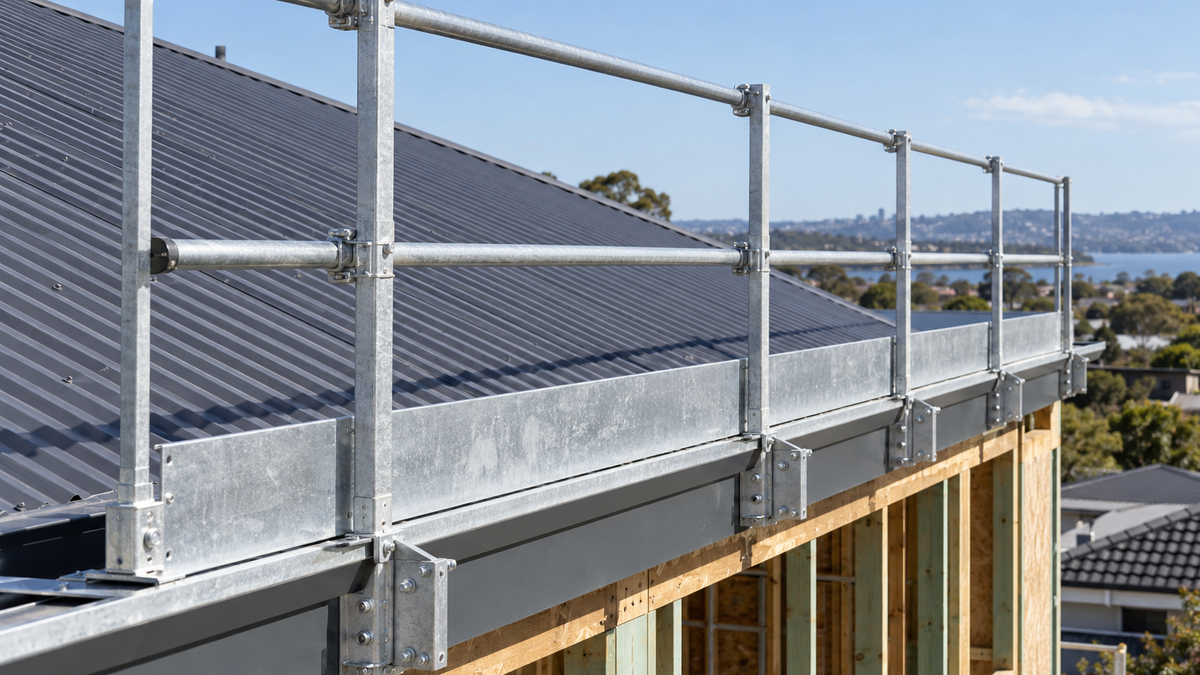
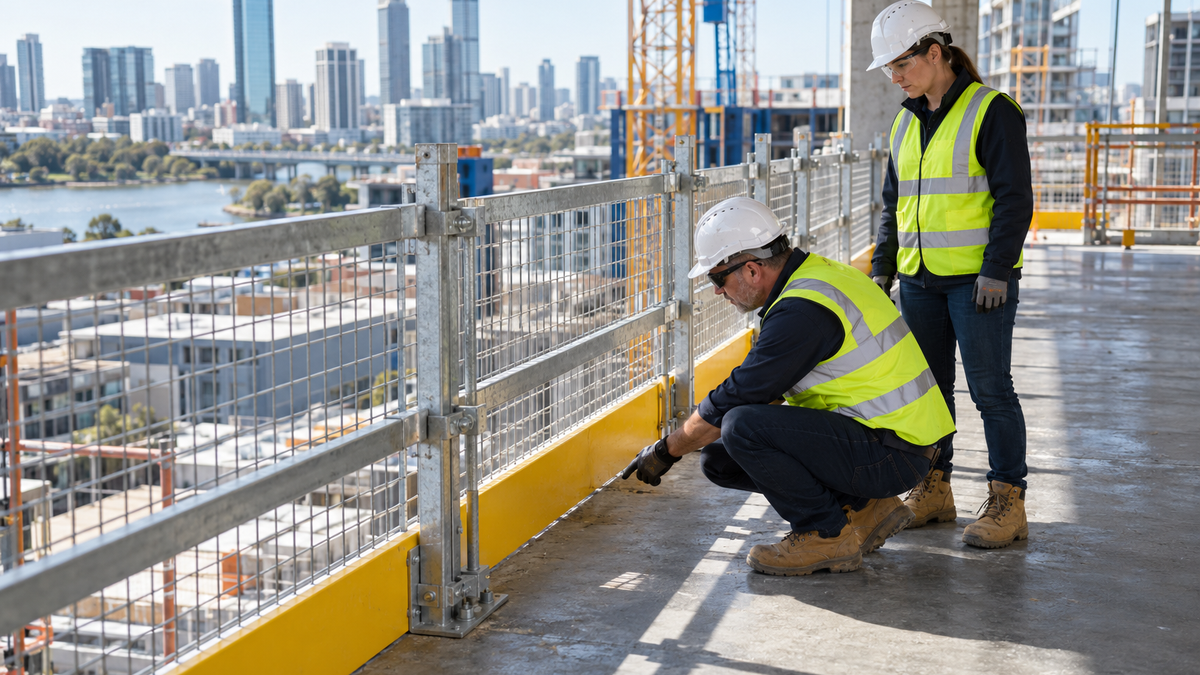
A guardrail system is the most common form of edge protection on commercial sites.
- A top rail positioned between 900mm and 1100mm above the work surface
- A mid-rail positioned at approximately the midpoint between the top rail and work surface
- A kickboard or toeboard at least 150mm high to prevent tools and materials from falling to lower levels
Guardrails must be capable of withstanding the load requirements specified in the standard. They are appropriate for roof perimeters, floor slab edges, elevated platforms, and most continuous-edge scenarios on commercial sites.
Scaffolding as Edge Protection
Scaffolding can serve the dual purpose of providing an elevated work platform and acting as edge protection for adjacent areas. In Australia, erecting, altering, or dismantling scaffolding over 4 metres in height requires a scaffolding licence issued under the relevant state WHS legislation. Ensure all scaffolding contractors hold the appropriate class of high-risk work licence before commencing.
Safety Mesh and Nets
Safety mesh and safety nets are passive fall arrest systems, not preventive edge protection. They do not prevent a fall; they arrest one after it begins. This is a critical legal distinction.
Safety mesh installed between roof battens and purlins can reduce the consequences of a fall through a roof surface. Still, it does not satisfy the obligation to install preventive edge protection at a roof perimeter. On commercial sites, safety mesh may be used as a supplementary control but cannot replace a compliant guardrail or barrier system at open edges.
Temporary Proprietary Edge Protection Systems
Modular and prefabricated edge protection systems are widely used on commercial construction sites in Australia. Proprietary systems offer the advantage of rapid installation, flexibility across changing site conditions, and compatibility with edge protection hire arrangements. When hiring or purchasing a proprietary system, verify that the manufacturer or supplier can provide documentation demonstrating compliance with AS/NZS 4994.2, including third-party testing certification where applicable.
Looking for compliant proprietary edge protection for your commercial project? Speak with an edge protection hire specialist who can specify the right system for your site conditions and height requirements.
Responsibilities and Duty Holders Under Australian Law
Key Definition: Duty Holder: A duty holder is any person or organisation that has a specific obligation under WHS legislation. On a commercial construction site, duty holders include the principal contractor, all subcontractors (as PCBUs), individual workers, designers, and, in certain circumstances, building owners.
The Principal Contractor's Obligations
The principal contractor carries the primary management responsibility for edge protection on a commercial construction site. This includes:
- Ensuring a WHS Management Plan is in place before work commences
- Ensuring edge protection is installed before workers are exposed to fall risks not after they have already begun working at height
- Conducting or overseeing regular inspection and maintenance of all edge protection systems
- Ensuring subcontractors are not removing or bypassing edge protection without authorisation and an approved replacement control
- Requiring a Safe Work Method Statement (SWMS) for all high-risk construction work involving fall risks
Subcontractor and Worker Obligations
Subcontractors operating as PCBUs share the duty to ensure the safety of their own workers. Individual workers have a duty to:
- Not remove, alter, or bypass edge protection without authorisation from the principal contractor
- Report any defect, damage, or missing edge protection to their supervisor immediately
- Comply with the SWMS and site-specific WHS management plan
Designers and Specifiers
Under the WHS Act's safe design obligations, designers of structures must identify and, where reasonably practicable, eliminate or minimise fall risks at the design stage before a single metre of edge protection is ever ordered. This means architects, structural engineers, and project designers should be considering roof access, maintenance access, and construction sequencing as part of the design process, not as an afterthought.
How to Conduct an Edge Protection Risk Assessment
A documented risk assessment is a legal requirement before commencing work at height on a commercial construction site. Follow these nine steps:
- Identify all elevated work areas on the site plan, including roofs, floor edges, voids, openings, and excavations
- Determine the fall height for each identified area, noting whether it exceeds the 2-metre regulatory threshold
- Identify who is exposed: workers, subcontractors, delivery personnel, and any visitors to the site
- Assess the consequences of a fall from each location, considering surface type, obstruction hazards, and likely injury severity
- Apply the hierarchy of controls: genuinely consider elimination and substitution before specifying edge protection as an engineering control
- Document the assessment as part of the site WHS management plan and prepare or review the SWMS for fall-risk activities
- Schedule regular inspection intervals: edge protection must be inspected before each work shift, after adverse weather events, and following any modification to the site
- Review the assessment whenever site conditions change, new trades commence work, or the scope of elevated works is altered
State-by-State Edge Protection Compliance: Key Differences
While the Model WHS framework provides a consistent national baseline, compliance obligations are enforced at the state and territory level and two jurisdictions operate under entirely different legislative frameworks.
Penalties for Non-Compliance with Edge Protection Requirements
The financial and criminal consequences of non-compliance with edge protection requirements under the Model WHS Act are substantial. The severity of the duty breach categorises penalties:
Beyond financial penalties, regulators have broad powers to issue improvement notices, prohibition notices (which can shut down a site immediately), and enforceable undertakings. A prohibition notice stopping work on a commercial construction project can cause significant delays and contract penalties that far exceed the cost of installing compliant edge protection in the first place.
In Victoria, penalties under the OHS Act 2004 differ from the figures above, visit WorkSafe Victoria for current figures applicable to Victorian sites.
Frequently Asked Questions: Edge Protection Compliance in Australia
What fall protection is required on commercial construction sites in Australia?
In Australia, the Model WHS Regulations require PCBUs to manage fall risks using the hierarchy of controls. When work is performed at 2 metres or more above the ground or a lower surface, physical engineering controls, such as guardrail systems, scaffolding, or proprietary edge protection, must be installed. A Safe Work Method Statement is also required for all high-risk construction work involving fall risks.
Is edge protection required at 2 metres or 3 metres in Australia?
Edge protection is required at a height of 2 metres under the Model WHS Regulations. When work is performed at 2 metres or more above the ground or a lower level, fall risks must be managed with physical controls. There is no 3-metre threshold in the national framework, though some jurisdictions may have specific provisions for certain types of work. Always check the applicable state code of practice.
Who is responsible for edge protection on a construction site?
The principal contractor is responsible for ensuring that edge protection is installed, maintained, and not removed without authorisation. All PCBUs on site, including subcontractors, share a duty to keep their workers safe. Individual workers have a duty not to remove or bypass edge protection. Designers also carry safe design obligations to address fall risks at the planning stage.
Can a safety harness replace edge protection on a commercial site?
No. A safety harness is a personal protective equipment (PPE) fall-arrest system; it sits at the lowest level of the hierarchy of controls. Under Australian WHS regulations, PPE can only be used when all higher-order controls (including engineering controls such as edge protection) are not reasonably practicable. On commercial construction sites, edge protection is almost always reasonably practicable and must be the primary control.
What happens if edge protection is not installed on a construction site?
Failure to install compliant edge protection can result in a WorkSafe improvement or prohibition notice, immediate site shutdown, and financial penalties ranging from $100,000 to $3,000,000 depending on the severity of the breach. If a worker is injured or killed as a result of the failure, duty holders, including individual managers, may face criminal prosecution and imprisonment. Civil liability and insurance consequences are additional significant risks.
Do the edge protection rules differ between states?
Yes. Most states and territories follow the Model WHS Regulations and the Safe Work Australia code of practice, providing a largely consistent national framework. However, Victoria operates under the OHS Act 2004 and OHS Regulations 2017, an entirely separate framework with different obligations and penalty structures. Western Australia is in a transitional period as it moves to harmonised WHS legislation. Always verify requirements with your state regulator before commencing commercial construction work.