Whether you're a licensed builder managing multiple residential sites, a roofing subcontractor working across varied roof types, an installer of rooftop solar panels, or an owner-builder navigating your first project, understanding residential edge protection systems is essential, both for keeping workers safe and staying on the right side of Australian WHS law.
Residential Edge Protection Systems: The Complete Australian Guide
Whether you're a licensed builder managing multiple residential sites, a roofing subcontractor working across varied roof types, an installer of rooftop solar panels, or an owner-builder navigating your first project, understanding residential edge protection systems is essential, both for keeping workers safe and staying on the right side of Australian WHS law.
This guide covers everything you need to know about residential edge protection systems in Australia, including:
- What edge protection is and when it's legally required
- Australian compliance requirements by state and territory
- The main system types and which suits each roof type
- Realistic Australian cost ranges for buying and hiring
- A practical buy vs. hire decision framework
- The easiest systems to install on existing homes
- What to look for when purchasing equipment
- Installation best practices and a comprehensive FAQ
What Is Residential Edge Protection?
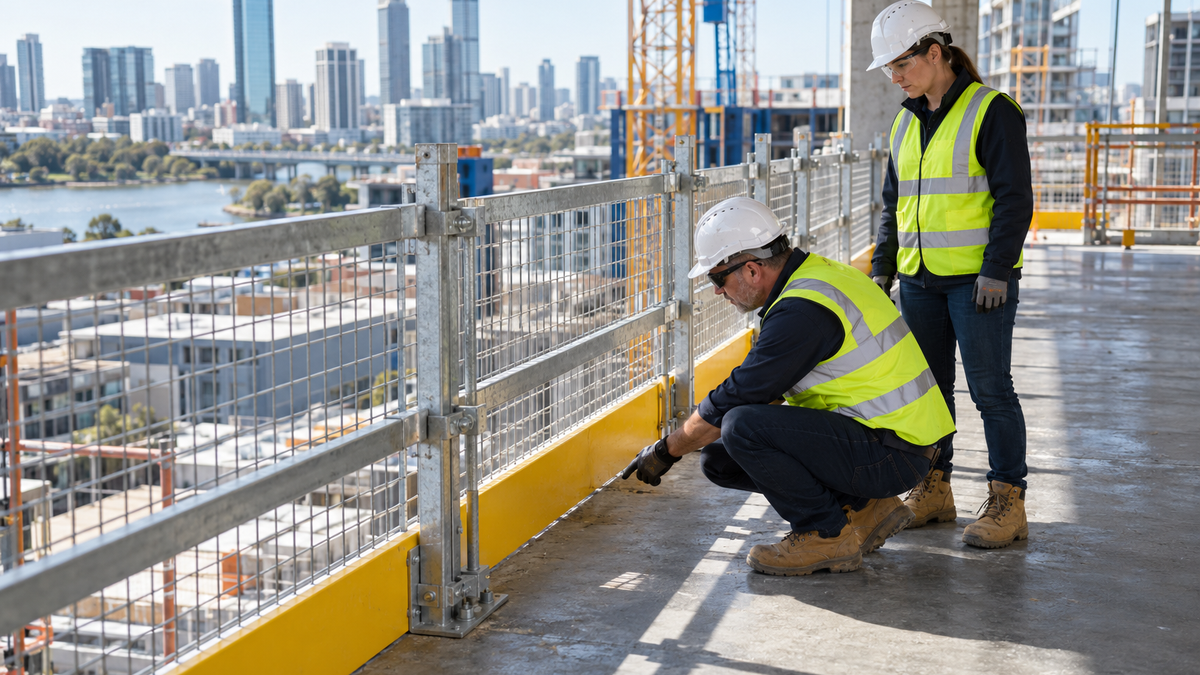
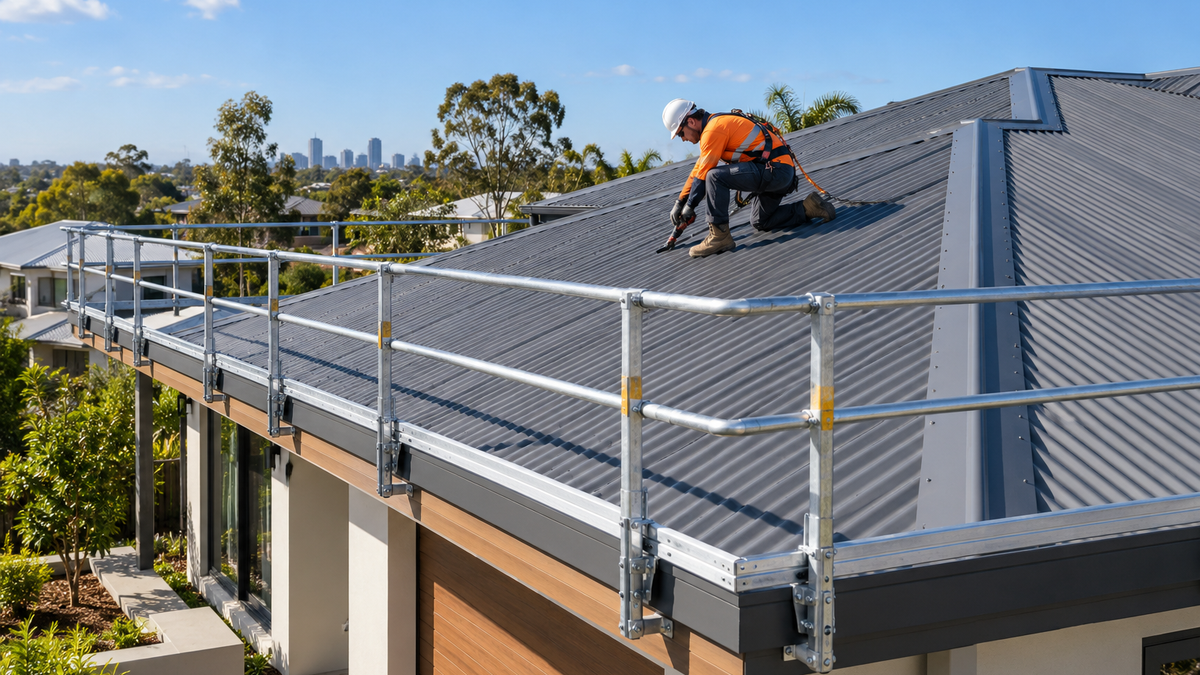
Residential edge protection is a temporary or permanent safety system installed at the perimeter of a house roof to prevent workers from falling during construction, renovation, or maintenance.
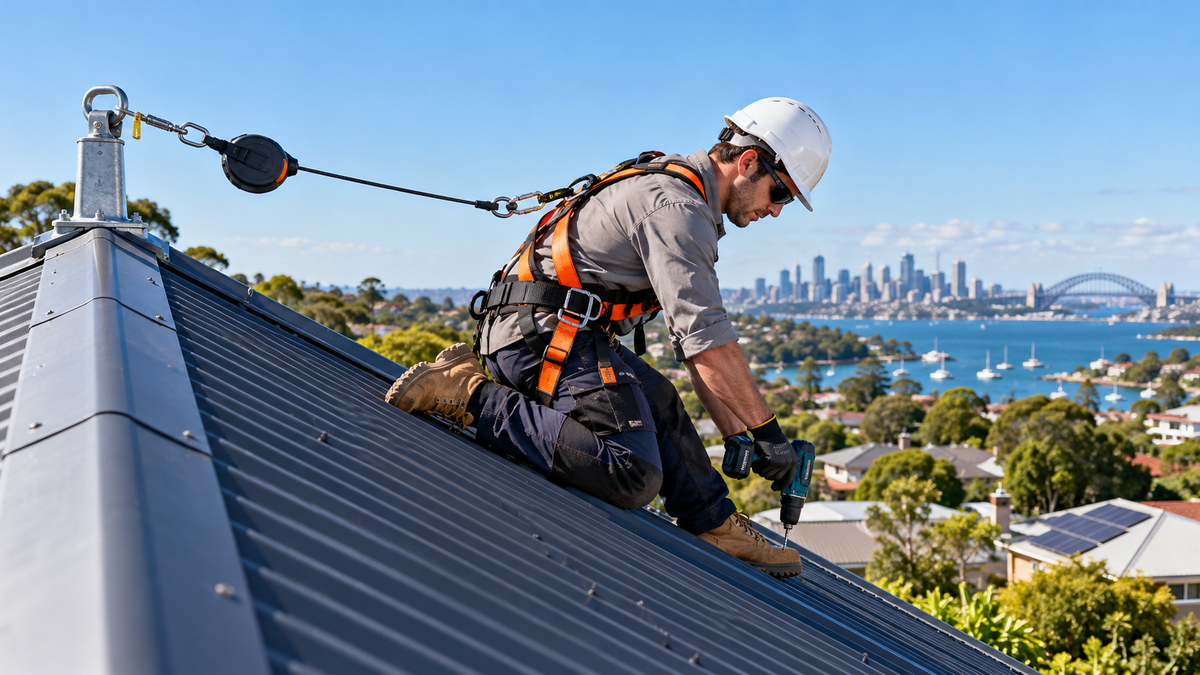
It is not the same as a fall arrest system. Edge protection, also called a perimeter guardrail, physically prevents a worker from reaching the roof edge. A fall arrest system (such as a safety harness connected to a roof anchor) is designed to stop a fall after it has begun. Both have their place, but edge protection is the primary control measure required under Australian WHS regulations for most residential roof work.
Key terms defined:
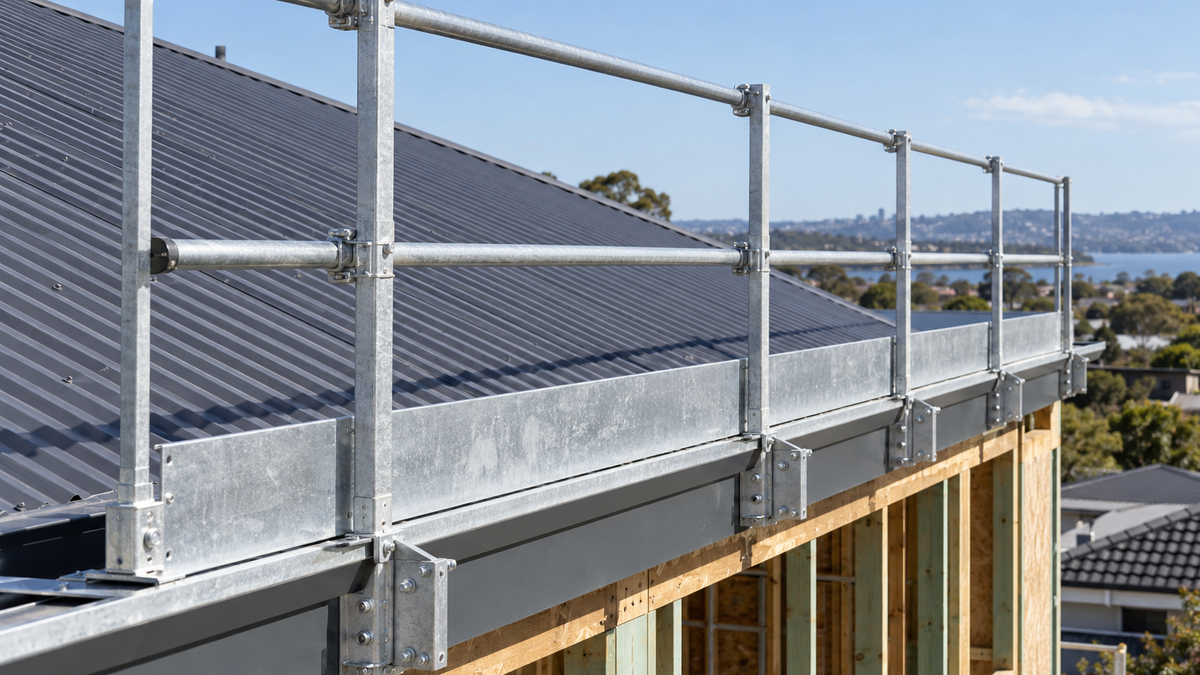
- Edge protection / perimeter guardrail: A barrier system, typically posts, top rails, and mid rails, installed at the roof perimeter to prevent falls.
- Temporary edge protection: A removable system installed for the duration of a project, then dismantled and reused elsewhere.
- Permanent edge protection: Fixed systems integrated into the building structure, common on commercial buildings but less typical in residential construction.
- Leading edge: The advancing, unprotected edge of a roof under construction.
- Perimeter edge: The finished outer edge of a completed or partially completed roof.
- Fall arrest: A system that arrests (stops) a fall in progress, distinct from edge protection, which prevents the fall from occurring.
In Summary: Residential edge protection is a physical barrier system at the roof perimeter. It is the primary fall prevention measure required by Australian WHS law, not a substitute for, and not to be confused with, harness-based fall arrest systems.
Australian Compliance Requirements for Residential Edge Protection
In Australia, edge protection is required by law for any work performed at or above 2 metres. This threshold is established under the harmonised Work Health and Safety Act 2011 (WHS Act) and reinforced by Safe Work Australia's Code of Practice: Managing the Risk of Falls at Workplaces (2022), which is the primary guidance document for fall prevention on residential construction sites.
The WHS Act has been adopted across most Australian states and territories, creating a broadly consistent national framework. However, some jurisdictions maintain their own legislation and specific compliance codes.
Who Is Responsible?
Under Australian WHS law, the duty of care is shared:
- Principal contractors carry the primary responsibility for ensuring edge protection is in place on a residential construction site.
- Subcontractors (including roofing trades) also carry obligations and can be held liable independently.
- Owner-builders are not exempt. If you are managing your own build and engaging subcontractors, you have WHS obligations equivalent to a principal contractor.
Relevant Australian Standards
The current standard for temporary edge protection is AS/NZS 4994.1:2023, Temporary edge protection, Part 1: General requirements. It covers the design, manufacture, installation and testing of temporary edge protection equipment. This edition replaced the previous 2009 standard.
Choosing the Right System for Your Roof Type
The type of edge protection that works for an existing residential roof depends primarily on the roof material, pitch, and access to structural attachment points.
Tiled Roofs (Concrete and Terracotta)
Concrete and terracotta tiles are brittle and vulnerable to cracking under point loads. Systems that concentrate weight on individual tiles, such as post bases without spreader plates, risk damage and potential warranty voidance.
Recommended: Freestanding counterbalanced systems or proprietary bracket-based systems that attach to rafters or fascia without loading the tiles. Use wide-footprint base pads wherever contact with the roof surface is required.
Metal and Colorbond Roofs
Metal roofing is more durable under load but presents a different challenge: it is significantly more slippery, particularly when wet. This must be addressed in your site risk assessment.
Recommended: Bracket-based clamp systems or modular guardrails with fascia attachment. Include non-slip surfaces in your risk assessment documentation for all workers accessing the roof.
Flat and Low-Pitch Roofs
Flat roofs and roofs below approximately 10 degrees pitch present a lower risk of sliding but still require perimeter protection. Parapet-mounted guardrail systems or perimeter-installed modular rails are the most common solution.
Recommended: Modular perimeter guardrail systems or parapet-mount brackets. Access platform systems compliant with AS 1657 may be appropriate for ongoing maintenance access.
Hip and Gable Roofs
Hip roofs are common in Australian residential construction and present a specific compliance challenge: corner sections are frequently overlooked, leaving gaps in perimeter protection. Ensure the system you select includes corner adapter components specifically designed for hip roof geometry.
Recommended: Modular guardrail systems with manufacturer-specified corner adapters. Verify that corner sections maintain the required rail heights and do not create openings greater than 450mm.
Should You Buy or Hire Residential Edge Protection?
For builders and contractors completing more than 3–4 residential projects per year, purchasing edge protection equipment typically delivers a better return on investment. For owner-builders or one-off renovations, hiring is usually more cost-effective and removes the burden of compliance management and storage.
The Easiest Temporary Edge Protection Systems to Install on Houses
The easiest temporary edge protection systems to install on residential houses in Australia are freestanding counterbalanced systems, followed by proprietary bracket-based systems, then modular aluminium guardrail systems.
Here is a ranked breakdown by ease of installation:
- Freestanding counterbalanced guardrail systems: No drilling, screwing, or structural penetration required. Counterweighted bases are positioned at the roof perimeter and rails simply lock into place. Skill level: Low–Moderate. Estimated setup time: 2–4 hours for an average single-storey perimeter. Tools required: Minimal (spanner, spirit level).
- Proprietary bracket-based systems: Engineered clips or clamps attach to fascia boards or rafter ends using standard hand tools. Rail sections connect between brackets. Skill level: Moderate. Estimated setup time: 3–5 hours. Tools required: Drill, spanners, measuring tape.
- Modular aluminium guardrail systems: Lighter than steel equivalents and faster to handle but still requires secure attachment to fascia or structural elements. Skill level: Moderate. Estimated setup time: 3-5 hours. Tools required: Drill, level, spanners.
- Roof anchor and horizontal lifeline hybrid: Not edge protection as defined by AS/NZS 4994.1, but deployable quickly for small or complex roof sections where full perimeter guarding is impractical. Should only be used as a supplementary measure. Skill level: Moderate–High (requires correct anchor installation). Setup time: 1–2 hours per anchor point.
In Summary: Freestanding counterbalanced systems require the least skill and fewest tools, making them the most accessible option for owner-builders and infrequent users. Bracket-based systems are the best balance of ease and compliance for existing residential roofs.
What to Look for When Buying Residential Edge Protection Equipment
When choosing residential edge protection, look for compliance certification, load ratings, roof-type compatibility, and supplier support as your primary evaluation criteria.
Use this checklist before committing to a purchase:
- ✅ Compliance with AS/NZS 4994.1: Confirm the system has been independently tested and certified to this Australian Standard. Do not rely on imported systems that claim compliance without documentation.
- ✅ Load rating: AS/NZS 4994.1 requires systems to withstand a minimum 900N lateral force. Verify that this is stated in the product's technical documentation.
- ✅ Roof-type compatibility: Check manufacturer specifications confirm suitability for your specific roof material (tile, metal, flat membrane) and pitch.
- ✅ Modular and expandable design: Can additional sections be added to cover larger perimeters? Modular systems offer significantly better long-term value.
- ✅ Material quality: Look for hot-dipped galvanised steel or marine-grade aluminium to resist corrosion in Australian coastal and high-humidity environments.
- ✅ Tool-free or quick-connect assembly: Reduces installation time and the risk of incorrectly assembled components.
- ✅ Supplier documentation and training support: Does the supplier provide detailed installation instructions, compliance documentation, and after-sales support?
- ✅ Warranty: A minimum 12-month structural warranty is the baseline; premium systems offer longer coverage. One specific system (EBracket) offers a lifetime manufacturer’s warranty.
- ✅ Replacement parts availability: Proprietary systems with limited parts availability create long-term compliance and cost risks.
- ✅ Weight and portability: If you're moving equipment between multiple residential sites, system weight per component directly affects practical usability.
In Summary: Always prioritise AS/NZS 4994.1 certification and verify load ratings above all other factors. Supplier support and parts of availability are critical for long-term compliance, particularly for contractors managing ongoing residential workloads.
Installation Best Practices for Residential Edge Protection
Following a consistent installation process protects your workers and creates a defensible WHS record. Use these steps as your standard procedure:
- Conduct a site risk assessment before any work begins. Safe Work Australia provides template risk assessment forms aligned to the Code of Practice: Managing the Risk of Falls at Workplaces (2022).
- Select the appropriate system based on roof type, pitch, perimeter dimensions, and project duration, using the guidance in this article.
- Review manufacturer's installation instructions thoroughly. Load ratings and attachment specifications vary between systems and cannot be assumed.
- Inspect all components before installation. Check for corrosion, deformation, cracked welds, or damaged connections. Do not use compromised components.
- Install posts and base connections strictly to manufacturer specifications. Over- or under-tightening anchor points affect load performance.
- Attach top rails and mid rails, checking that no gap exceeds 450mm. Gaps larger than this are non-compliant under AS/NZS 4994.1.
- Conduct a visual compliance check once fully installed. Walk the perimeter, test rail stability, and confirm corner sections are complete.
- Document installation with photographs and retain records for your WHS file. This is critical evidence of due diligence in the event of an incident or regulator inspection.
- Inspect the system daily if work continues over multiple days. Wind, accidental impact, and structural movement can affect system integrity.
- Follow the manufacturer's removal procedure carefully, particularly on tiled roofs, to avoid damage to roofing materials during dismantling.
In Summary: A documented, step-by-step installation process, from pre-installation risk assessment to daily inspection, is both a safety requirement and legal protection. Always retain photographic evidence of compliant installation.
Frequently Asked Questions
Is edge protection required by law in Australia for residential roofing?
Yes. Under the harmonised Work Health and Safety Act 2011 and Safe Work Australia's Code of Practice: Managing the Risk of Falls at Workplaces (2022), edge protection is required for any residential roofing work performed at or above 2 metres. This applies across all states and territories, although Victoria has its own equivalent legislation under the OHS Act 2004.
Can an owner-builder install edge protection themselves?
Yes, owner-builders can install temporary edge protection themselves, provided the system complies with AS/NZS 4994.1 and is installed according to the manufacturer's instructions. However, owner-builders still carry WHS obligations as a person conducting a business or undertaking (PCBU) and are responsible for ensuring all workers on their site are protected. For complex or steep roofs, professional installation is strongly recommended.
What is the difference between edge protection and safety harness system?
Edge protection is a physical barrier, a guardrail system that prevents a worker from reaching the roof edge. A safety harness system is a fall arrest device that stops a fall after it has started. Under Australian WHS law, edge protection is the preferred primary control measure. Harnesses are used as a supplementary or secondary control when edge protection is not practicable for a specific task.
How long can temporary edge protection remain installed?
There is no prescribed maximum duration for temporary edge protection under Australian standards, but "temporary" systems are defined by AS/NZS 4994.1 as those intended for removal after the work is complete. Systems should be inspected daily when in continuous use. For projects extending beyond a few weeks, consult the manufacturer on any additional inspection or maintenance requirements to maintain compliance.
Does edge protection damage roof tiles?
A correctly specified and installed system should not damage roof tiles. Freestanding counterbalanced systems and fascia-mounted bracket systems are specifically designed to avoid tile contact or point loading. Systems that place posts or bases directly onto tiles must use wide-footprint spreader pads to distribute load. Avoid systems designed for metal roofs when working on tile, the attachment methods are fundamentally different.
What Australian Standard covers residential edge protection?
AS/NZS 4994.1:2023, Temporary edge protection, Part 1: Systems for roof and floor edges is the primary Australian Standard for residential and commercial temporary edge protection systems. All compliant products should carry documentation confirming testing against this standard. Roof anchor systems used in conjunction with edge protection must separately comply with AS/NZS 1891.4.Note: systems certified under the preceeding AS/NZ 4994.1:2009 are grandfathered and continue to be compliant systems in Australia.
Can edge protection be used in a two-storey house?
Yes, but two-storey applications introduce additional height and complexity. Systems must be rated for the relevant height, and the increased fall distance makes compliance even more critical. Not all systems rated for single-storey applications are certified for two-storey use; always verify the manufacturer's height rating. Professional installation is strongly recommended for two-storey residential projects.
What happens if a builder doesn't use edge protection in Australia?
WHS regulators including SafeWork NSW, WorkSafe Victoria, and their state equivalents can issue on-the-spot fines, improvement notices, and stop-work orders for absent or non-compliant edge protection. Beyond regulatory penalties, a builder who fails to provide compliant edge protection, and a worker is injured faces significant personal liability, civil claims, and potential criminal prosecution under the WHS Act. The financial and reputational costs of non-compliance far exceed the cost of proper equipment.