Fall Arrest Equipment for Roofing: What's Required in Australia
Falls from height remain the leading cause of workplace fatalities in Australia. According to Safe Work Australia, falls account for approximately 25% of all worker deaths each year and roofing work consistently features among the highest-risk activities. Despite this, many roofing contractors, site managers, and WHS officers remain unclear on exactly when fall arrest equipment is legally required, which components must be used, and how fall arrest differs from other forms of height protection.
This guide answers those questions directly. It covers the legal requirements for fall-arrest equipment for roofing work in Australia, the specific components that must be in place, the Australian Standards that apply to each, and how to choose between fall-arrest and alternative controls such as edge protection. Whether you're preparing for a WorkSafe audit, procuring equipment for a new project, or simply trying to understand your obligations, this is the definitive reference.
What Is a Fall Arrest System?
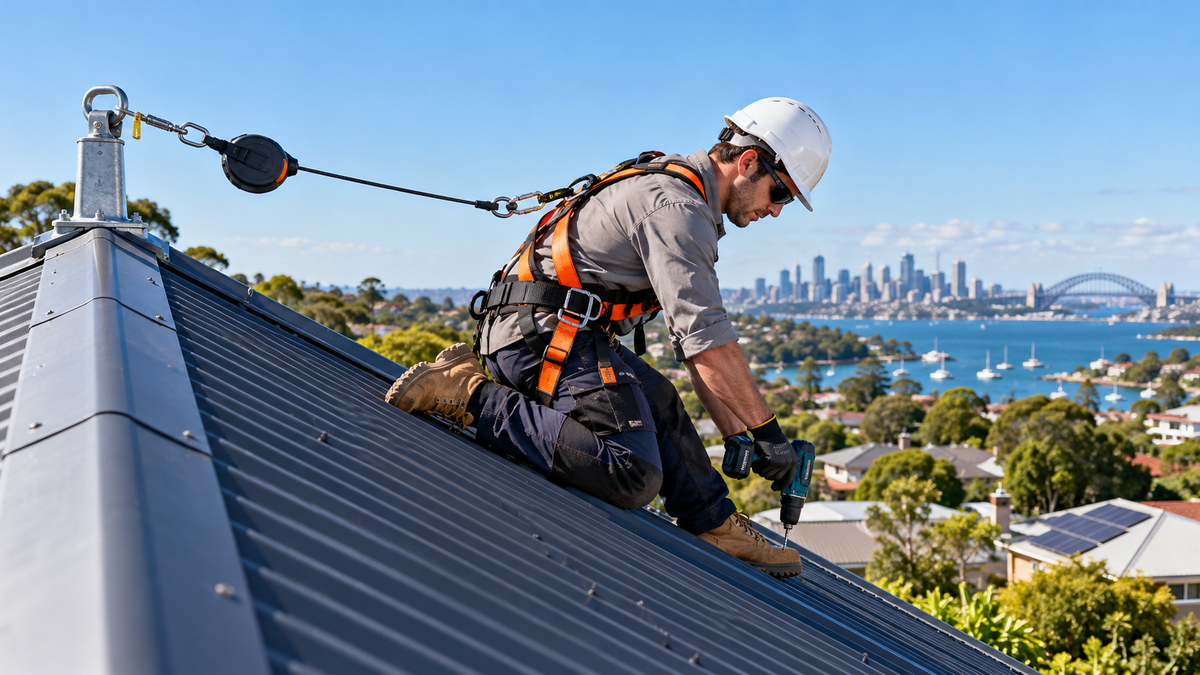
A fall arrest system is a form of height safety equipment designed to stop a worker mid-fall before they reach a lower level or the ground. Unlike fall prevention systems, it does not prevent the fall itself; it arrests the fall after it has begun. A compliant fall arrest system consists of interconnected components including a full-body harness, an energy-absorbing lanyard or self-retracting lifeline, and a certified anchor point.
The system works by absorbing and redirecting the kinetic energy generated during a fall. When a worker falls, the lanyard or self-retracting lifeline arrests the fall and the energy absorber, typically a tear-webbing mechanism inside the lanyard, deploys to reduce the peak force transmitted to the worker's body to a survivable level (generally no more than 6 kN under AS/NZS standards).
One critical and frequently misunderstood concept is fall clearance distance: the total vertical space required below the worker for the system to arrest the fall before impact. This includes the free-fall distance, the energy absorber deployment length, harness stretch, and the worker's own height. If insufficient clearance exists below the work area, a lanyard-based fall-arrest system may not be appropriate, and this calculation must be performed before any roofing task begins.
It is important to note that fall arrest is considered a lower-order control under the hierarchy of controls. It is used when higher-order controls such as edge protection or scaffolding are not reasonably practicable.[PC1]
Key Components of a Fall Arrest System
- Full-body harness: Distributes fall forces across the thighs, chest, and shoulders. Must include a dorsal D-ring attachment point for fall arrest use.
- Lanyard (shock-absorbing) or self-retracting lifeline (SRL): Connects the harness to the anchor point. Shock-absorbing lanyards extend on deployment; SRLs retract continuously, allowing far less free fall.
- Anchor point or static line: The fixed point to which the lanyard or SRL is connected. Must be capable of withstanding the dynamic forces of a fall.
- Connectors and karabiners: Hardware that links system components. Must be self-locking for all fall arrest applications.
Fall Arrest vs Fall Prevention: What's the Difference?
Unlike fall prevention, fall arrest does not prevent a fall; instead, it limits the consequences of a fall that has already begun. This distinction is fundamental to understanding how Australian WHS law treats the two approaches and why fall prevention is always the preferred option.
The Work Health and Safety Regulations 2017 and the Safe Work Australia Code of Practice: Managing the Risk of Falls at Workplaces both require that height risks be managed using the hierarchy of controls, a ranked framework that prioritises the most effective control measures first:
- Eliminate the need to work at height where possible
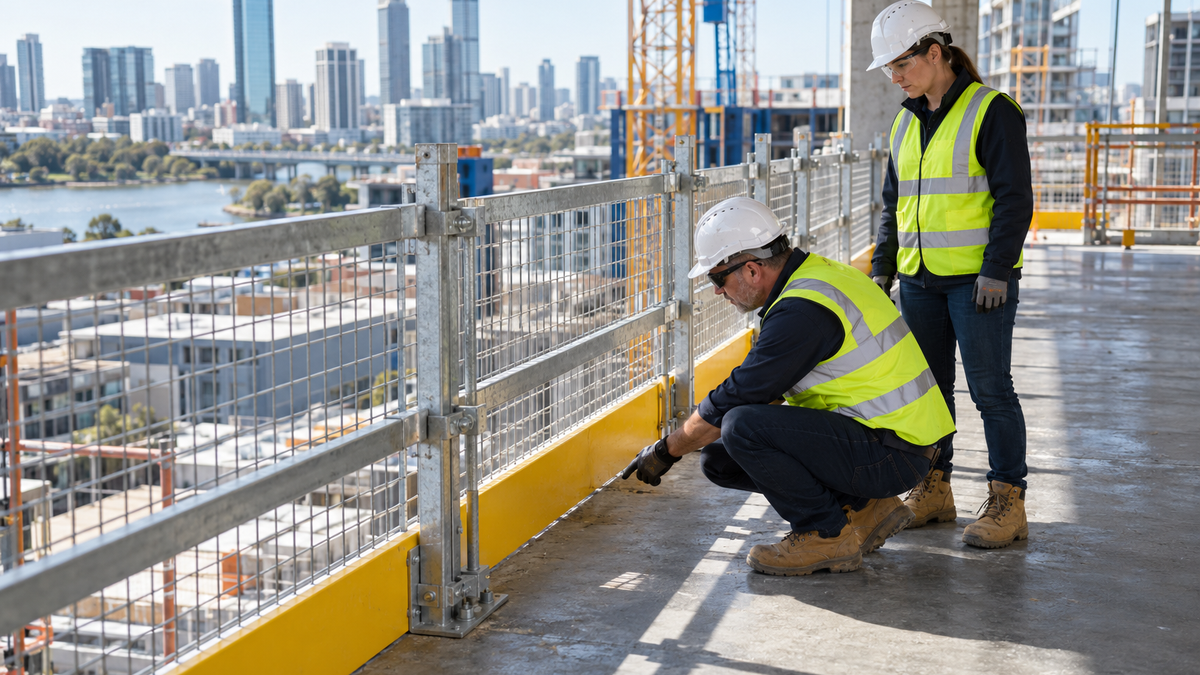
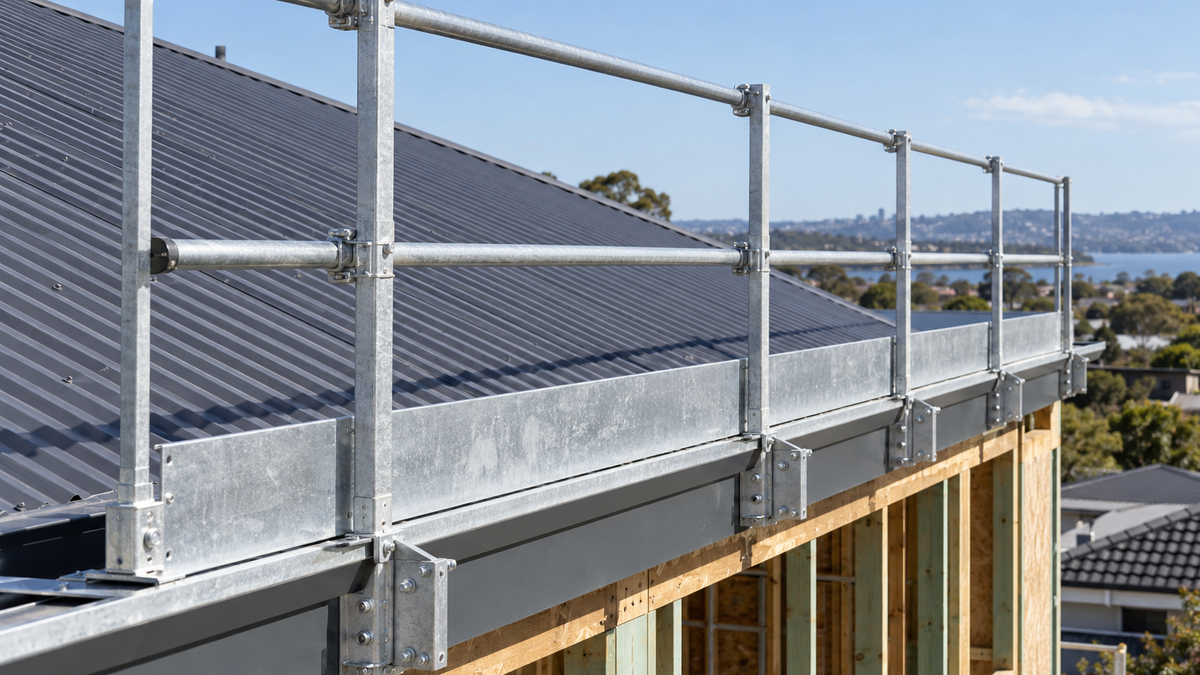
- Passive fall prevention: guardrails, edge protection, scaffolding, safety mesh
- Work positioning systems: restraint systems that prevent a worker from reaching a fall hazard
- Fall arrest systems: harness, lanyard, anchor point
- Administrative controls: training, supervision, safe work procedures
Fall arrest sits at step four. It is only appropriate when higher-order controls are not reasonably practicable.
When Is Fall Arrest Required for Roofing Work in Australia?
Under Australian WHS legislation, fall protection is required whenever a worker could fall from a height of 2 metres or more. For roofing work, this threshold is almost always met.
The specific obligations are set out in the Work Health and Safety Regulations 2017, Regulations 78 and 79, which require a Person Conducting a Business or Undertaking (PCBU) to manage the risk of a fall using the hierarchy of controls. These Model Regulations have been adopted across most Australian states and territories, with SafeWork NSW, WorkSafe Victoria, SafeWork SA, WorkSafe Queensland, and other state regulators each enforcing equivalent obligations under their jurisdictions.
Key legal threshold: A PCBU must manage the risk of a fall where a worker could fall 2 metres or more. For roofing work on a standard single-storey residential building, this threshold is almost universally triggered.
There are three primary scenarios where fall arrest is specifically appropriate for roofing work in Australia:
- Edge protection is not reasonably practicable to install, for example, on a steeply pitched or geometrically complex roof where installing compliant guardrails or scaffolding at every edge would be disproportionately difficult or hazardous in itself.
- Work is performed on or near fragile roofing materials including skylights, fibrous cement (asbestos-free) sheeting, or corroded metal roofing that cannot reliably support a worker's weight.
- Work is of short duration or temporary nature
- Where installing full perimeter edge protection would be disproportionate to the risk and duration of the task, such as a brief maintenance inspection or single fastener replacement.
Does Roof Pitch Affect Fall Protection Requirements?
Yes, roof pitch is a significant factor in determining which control is appropriate. As pitch increases, the effectiveness and practicality of conventional edge protection decreases, and the risk of an uncontrolled slide to the edge increases.
The Safe Work Australia Code of Practice: Managing the Risk of Falls at Workplaces acknowledges that roofs with pitches of approximately 35° or more make conventional guardrail-based edge protection less effective and more difficult to install safely.
Fall Arrest vs Edge Protection: Which Should You Use?
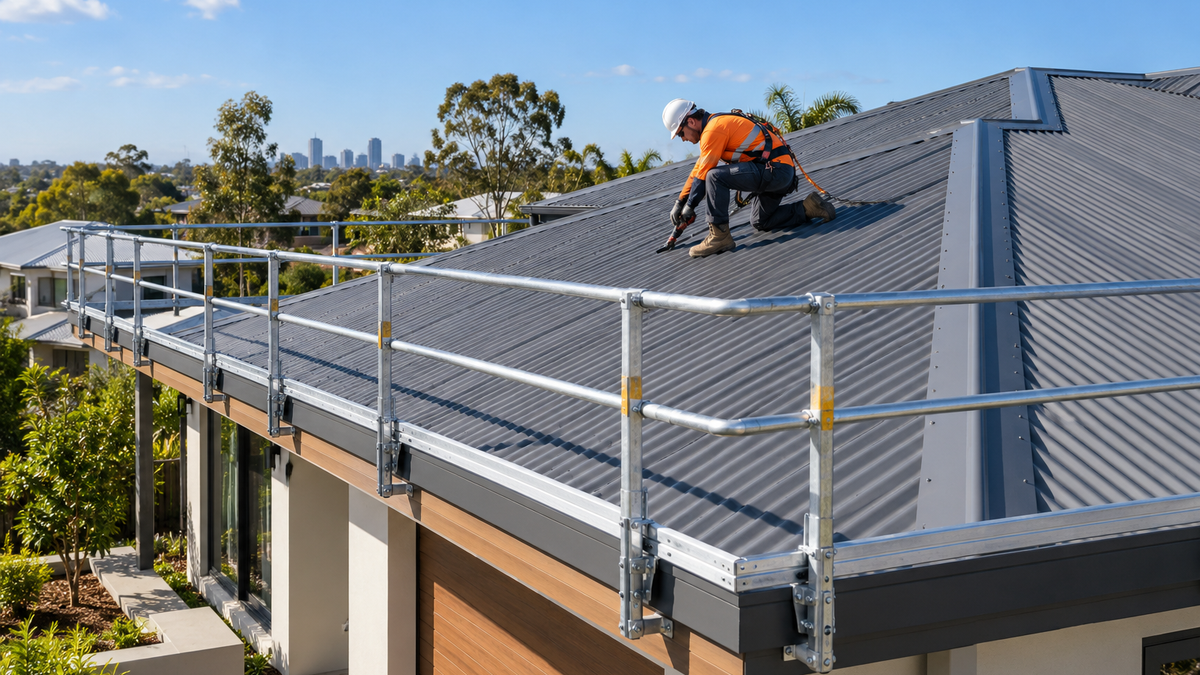
Edge protection should always be your first choice where it is reasonably practicable to install it. Fall arrest systems are used when edge protection cannot adequately protect workers due to the roof's design, pitch, or the nature of the work.
This is a common point of confusion in the roofing industry. Many contractors default to harnesses because they are familiar and portable, but under Australian WHS law, this reasoning alone does not satisfy the hierarchy of controls. A PCBU must be able to demonstrate that edge protection was genuinely not reasonably practicable before relying solely on fall arrest.
What Fall Arrest Equipment Is Required for Roofing Work in Australia?
A compliant fall arrest system for roofing work in Australia must include the following certified components, each meeting the relevant AS/NZS standard:
1. Full-Body Harness
A full-body harness must comply with AS/NZS 1891.1 (Industrial fall-arrest systems and devices harnesses and ancillary equipment). It must be correctly sized and adjusted to the individual worker; an improperly fitted harness can cause serious injury during fall arrest, particularly around the groin and chest straps. The harness must include a dorsal D-ring (positioned between the shoulder blades) as the attachment point for fall arrest lanyards or SRLs. Chest and sternal D-rings are not rated for fall arrest use.
2. Energy-Absorbing Lanyard or Self-Retracting Lifeline (SRL)
Shock-absorbing lanyards must comply with AS/NZS 1891.1. They allow the worker to move across the roof but require significantly more fall clearance beneath the work area, typically 6 metres or more when accounting for free fall, deployment, harness stretch, and worker height. This makes them unsuitable for many lower-roof applications without careful calculation.
Self-retracting lifelines (SRLs) must comply with AS/NZS 1891.3. They retract the line continuously as the worker moves and lock it within centimetres of the start of a fall, dramatically reducing the free-fall distance. SRLs are generally preferred for roofing applications where fall clearance is limited, and they offer greater freedom of movement across the work area.
The fall clearance distance must always be calculated before selecting a lanyard system. If the clearance to the next level below is insufficient for the lanyard type being used, the system cannot be safely deployed.
3. Anchor Points
Anchor points, whether permanent or temporary, must comply with AS/NZS 5532 (Manufacturing requirements for anchor devices used in fall-arrest systems) and be installed in accordance with AS/NZS 1891.4 (Selection, use, and maintenance of industrial fall-arrest systems). They must be rated to withstand the dynamic forces of a fall, with a minimum design load of 15 kN.
Types of anchor points used in roofing include:
- Permanent roof anchors: Fixed to the roof structure; must be installed by a licensed roof plumber or structural engineer and certified on completion
- Temporary anchor straps: Looped over the roof ridge; suitable only for temporary use and specific load ratings
- Static line (horizontal lifeline) systems: Allow workers to travel across a roof while remaining connected; must be engineered and rated for the number of users
Anchor points must be installed by a competent person , as defined under the WHS Regulations, someone with the specific skills, knowledge, and experience to perform the task safely.
4. Connectors and Karabiners
All connectors must comply with AS/NZS 1891.1 and be self-locking, either screw-gate or triple-action locking, for all fall arrest applications. Non-locking snap hooks must never be used in fall arrest systems. The gate strength and locking mechanism must be rated for the load demands of a dynamic fall event.
5. Rescue and Retrieval Plan
A rescue plan is not a piece of equipment, but it is legally required before fall arrest work commences. Suspension trauma , also called harness hang syndrome, occurs when a worker hangs motionless in a harness after a fall. The compression of leg veins restricts blood flow, and serious injury or death can occur within 10 to 30 minutes. A rescue plan must specify how a suspended worker will be quickly retrieved, by whom, and with what equipment. Relying on emergency services alone does not satisfy this requirement.
Australian Standards That Apply to Fall Arrest Equipment
All fall arrest equipment used in Australia must be certified to the relevant AS/NZS standard by a third-party certification body; manufacturer self-declaration is not sufficient. Workers and procurement managers should check that equipment carries visible certification markings and that the specific standard number is referenced.
Inspection, Maintenance, and Competency Requirements
All fall arrest equipment must be visually inspected by the user before each use and formally inspected by a competent person at intervals specified in AS/NZS 1891.4 and the manufacturer's guidelines.
Key inspection and maintenance obligations include:
- Pre-use inspection: Check harness webbing, stitching, buckles, D-rings, and connectors for wear, damage, UV degradation, chemical exposure, or deformation
- Formal periodic inspection: Conducted by a competent person typically every 6 or 12 months, depending on frequency of use and environmental conditions
- Immediate retirement after a fall: Any equipment that has arrested a fall must be taken out of service immediately, even if no visible damage is apparent. The internal energy absorber cannot be reset and the structural integrity of the harness webbing may be compromised
- Service life: Fall arrest equipment has a finite service life typically a maximum of 10 years from the date of manufacture, or earlier as specified by the manufacturer
Workers using fall arrest equipment in Australia must be trained and deemed competent. The nationally recognised unit of competency Work Safely at Heights (RIIWHS204E or the equivalent construction sector unit CPCCWHS0001) sets the minimum standard. This training is not optional; it is a regulatory expectation under the WHS Regulations.
Frequently Asked Questions
Q: What height requires fall protection on a roof in Australia?
Under the Work Health and Safety Regulations 2017 (Regulation 78), fall protection is required when a worker could fall 2 metres or more. Virtually all roofing work on standard residential or commercial buildings triggers this threshold. PCBUs must implement controls using the hierarchy of controls, starting with fall prevention before considering fall arrest.
Q: Can I use a harness instead of edge protection on a roof?
Not simply by preference. Under Australian WHS law, edge protection is a higher-order control and must be used where reasonably practicable. A fall arrest harness system is only appropriate when edge protection cannot adequately protect workers due to the roof's pitch, design, or the nature of the work. The choice must be documented and justifiable.
Q: What is the maximum free-fall distance for a fall arrest system?
The maximum free-fall distance before arrest depends on the lanyard or SRL type, but AS/NZS standards limit the arrest force to 6 kN. For shock-absorbing lanyards, free fall is typically limited to 2 metres before the energy absorber activates. However, the total fall clearance required, including deployment, harness stretch, and worker height, may be 6 metres or more. SRLs lock within centimetres and require significantly less clearance.
Q: How often does fall arrest equipment need to be inspected?
The user must inspect equipment before every use. Formal inspections by a competent person must occur at intervals set out in AS/NZS 1891.4, typically every 6 to 12 months. Equipment involved in a fall must be retired immediately, regardless of when it was last inspected.
Q: What is suspension trauma and why does it matter?
Suspension trauma (harness hang syndrome) occurs when a worker remains suspended motionless in a harness after a fall. The leg straps compress the femoral veins, restricting the return of blood to the heart. Serious cardiovascular complications or death can occur within 10 to 30 minutes. This is why a rescue plan is legally required before fall arrest work commences; emergency services' response times are often too slow to prevent injury.
Q: Do I need a rescue plan when using fall arrest equipment?
Yes, this is a legal requirement under Australian WHS legislation, not optional guidance. A rescue plan must be in place before work begins and identify how a suspended worker will be safely retrieved within a timeframe that prevents suspension trauma. The plan must be practicable for the specific site conditions.
Q: Who is responsible for providing fall arrest equipment on a worksite?
The PCBU (Person Conducting a Business or Undertaking), typically the employer, principal contractor, or business engaging workers, has the primary duty to provide and maintain fall arrest equipment and to ensure it is used correctly. This duty cannot be fully delegated to the individual worker. Where multiple PCBUs are present (e.g., a principal contractor and a roofing subcontractor), each has overlapping duties to consult, cooperate, and coordinate with the other.