Edge Protection Compliance in Australia: What Builders Must Know
Falls from height remain the single leading cause of workplace fatalities in the Australian construction industry. According to Safe Work Australia, falls account for a disproportionate share of both deaths and serious injuries on construction sites each year, and the majority of those incidents involve unprotected roof and floor edges. The consequence is not only human tragedy but serious legal and financial exposure for every person in the chain of responsibility.
What Is Edge Protection?
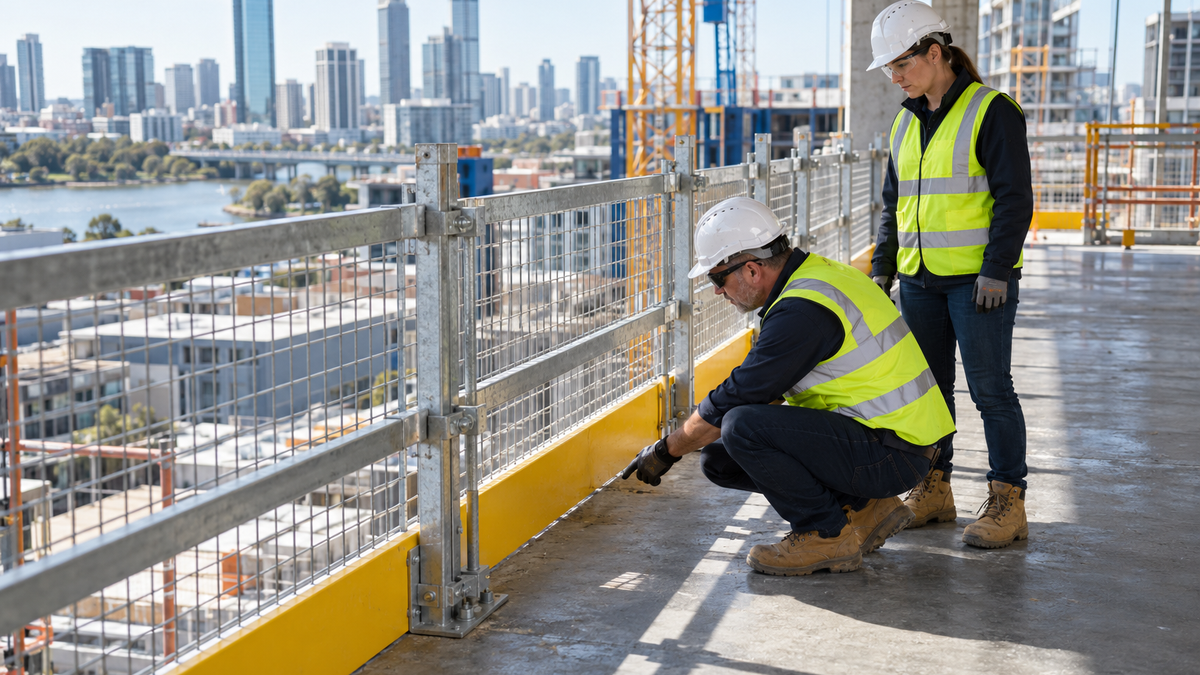
Edge protection is a passive fall prevention system installed at the open edges of roofs, floors, formwork, or elevated work surfaces to prevent workers, tools, and materials from falling to a lower level. It physically barriers an open edge and does not rely on worker action or decision-making to function.
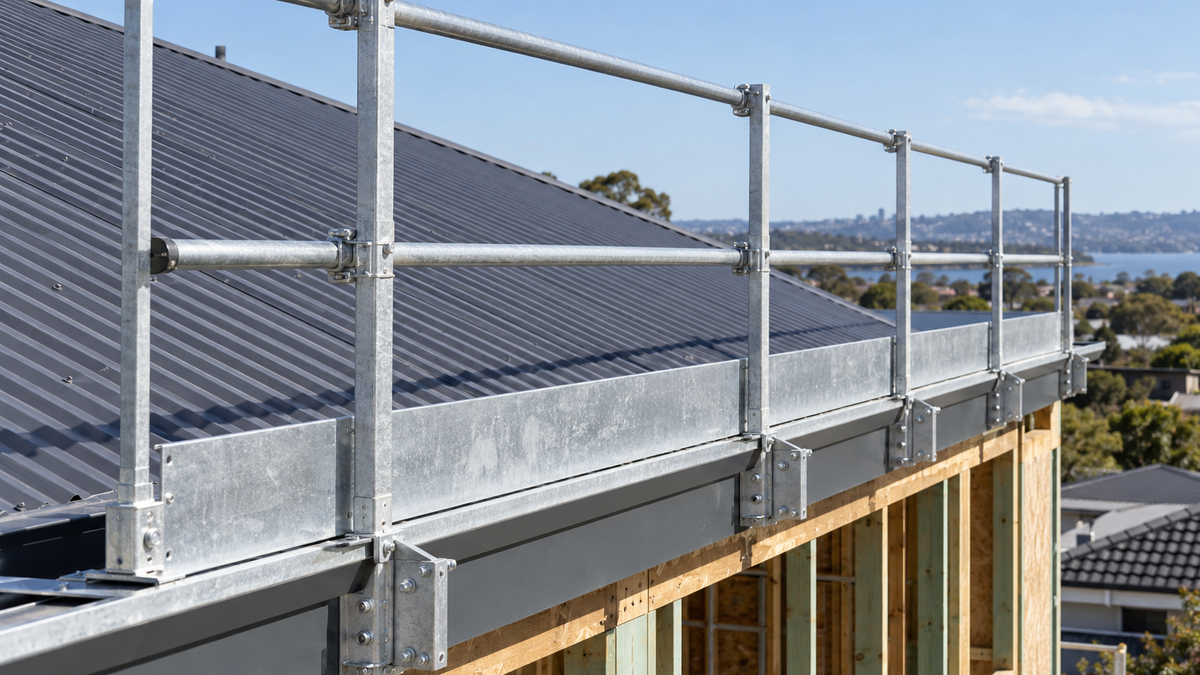
A compliant edge protection system consists of five core physical components:
- Standards (uprights/posts): Vertical members anchored to the structure that support the entire system
- Top rail: The uppermost horizontal barrier, positioned to stop a falling worker
- Mid rail: A horizontal rail positioned approximately halfway between the top rail and toe board
- Bottom rail or toe board: Most systems use a bottom rail. A toe board or kickboard may be required where the roof pitch, tools or equipment create a risk of items falling through the space between the roof surface and the mid rail.
- Connection and anchorage system: The clamps, ties, base plates, or brackets that secure the system to the structure
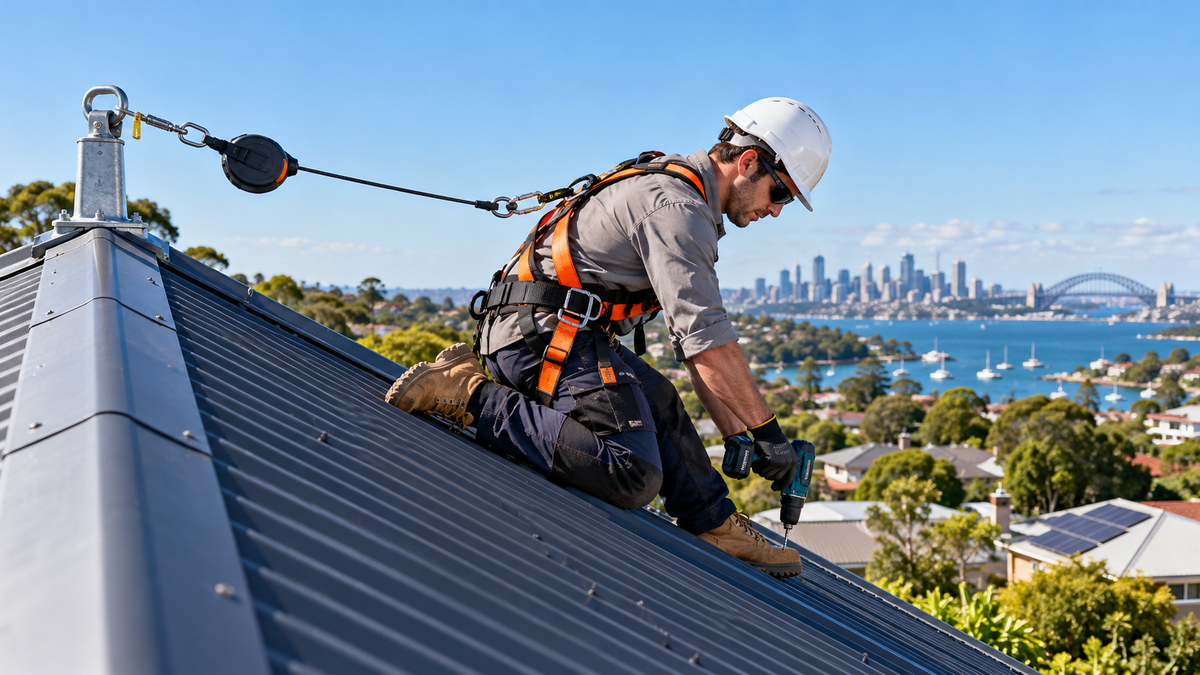
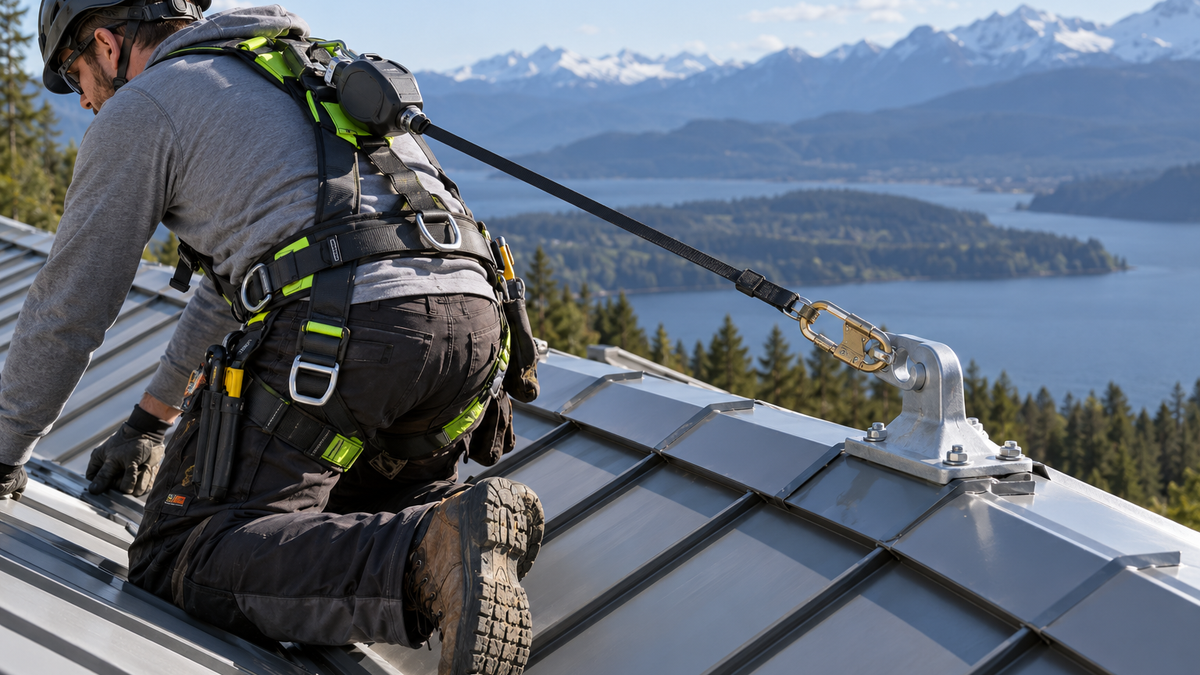
Edge protection is distinct from scaffolding, which provides a complete elevated work platform, and from fall arrest systems such as harnesses, which catch a worker after a fall has already begun. Edge protection is classified as a passive fall prevention control, the highest-performing category of fall prevention measure because it eliminates the fall hazard entirely without depending on worker behavior.
The Legal Framework: WHS Regulations and Australian Standards
Australian edge protection compliance sits at the intersection of workplace health and safety legislation and a specific technical standard. Understanding both layers is essential.
The Model Work Health and Safety Regulations
Australia operates under harmonized WHS legislation based on the Model Work Health and Safety Regulations, which have been adopted by New South Wales, Queensland, South Australia, the Northern Territory, the Australian Capital Territory, Tasmania, and Western Australia (noting that Victoria, while aligned in principle, operates under its own Occupational Health and Safety Act 2004).
Regulation 36 of the model WHS Regulations requires a person conducting a business or undertaking (PCBU) to manage the risk of a person falling from one level to another. Regulation 212 imposes specific duties on persons conducting construction work, requiring that falls from a height of 2 meters or more are prevented through the application of the hierarchy of controls.
The hierarchy of controls for fall prevention, in order of preference, is:
- Eliminate the risk: redesign the work so height is not required
- Passive fall prevention: edge protection, scaffolding, or safety mesh (preferred engineering controls)
- Work positioning systems: travel restraint systems that prevent workers from reaching the edge
- Fall arrest systems: harnesses and lanyards that arrest a fall after it begins
- Administrative controls and PPE: training, signage, and additional personal protective equipment as a supplement only
Under this hierarchy, edge protection is the preferred control once elimination is not practicable. Fall arrest systems, harnesses, sit significantly lower in the hierarchy and are not an acceptable substitute for edge protection in most construction scenarios.
AS/NZS 4994.1:2023 The Key Standard Explained
AS/NZS 4994.1:2023 is the Australian and New Zealand Standard for Temporary Edge Protection, Part 1: General Requirements. It specifies the design, performance, installation, and inspection requirements for temporary edge protection systems used during construction work.
AS/NZS 4994.1:2023 is the current version of this standard and supersedes the previous edition. Compliance with this standard is treated by WHS regulators as evidence that a builder has met their regulatory obligations for edge protection. While the standard itself is not law, the WHS Regulations require that risk controls be adequate, and a system meeting AS/NZS 4994.1:2023 satisfies that requirement.
Key technical requirements under AS/NZS 4994.1:2023:
- Top rail: 900mm above the working surface
- Mid rail: about 450mm above the working surface (midpoint)
- Bottom rail: needed where roof pitch, work activities or equipment risk tools or materials falling between the roof surface and the mid rail
- Top rail load: must withstand at least 630N in any direction
- Inspection: by a competent person before first use
- Proprietary systems: use strictly to the manufacturer’s specifications
- Access gates: self-closing and self-latching
- Continuity: no unprotected gaps at corners, returns or transitions
Important: This table summarises key requirements for reference purposes. Builders and safety professionals must obtain and read the full AS/NZS 4994.1:2023 standard directly through Standards Australia to ensure complete compliance.
Systems certified under the previous AS/NZS 4994.1:2009 Standard are grandfathered and continue to be accepted as compliant to Standard.
When Is Edge Protection Required? Triggers and Thresholds
Edge protection, or an equivalent or superior fall prevention control, is required in Australia when construction work is performed at 2 meters or more above a lower surface, when work is near any open edge or void that presents a fall risk, or when a risk assessment identifies a credible risk of a person falling.
The 2-metre threshold is the primary legal trigger. However, in practice, the obligation is risk-based: if work near an open edge presents a fall hazard below 2 meters (for example, near a sharply raked or uneven surface), a risk assessment may still require controls to be implemented.
Residential Roofing Work Specifically
Residential roof work is one of the highest-risk categories for falls in Australian construction, and one of the most frequently inspected by WorkSafe and SafeWork officers. Edge protection is required on residential roofs whenever a worker is exposed to the risk of falling from an eave edge, gable end, ridgeline, or roof opening.
Specific residential roofing scenarios include:
- Sloped roofs: Edge protection must be installed at all eave edges. On steeper pitches, additional measures may be required to prevent workers sliding toward the edge before reaching it.
- Flat and low-pitch roofs: Edge protection is still required at all perimeter edges. The low pitch does not reduce the fall risk.
- Gable ends: Open gable ends must be treated as leading edges and protected accordingly.
- Roof penetrations and skylights: Any opening through which a person could fall, including unglazed skylight frames and service penetrations, must be protected with covers rated to support a person's weight or with edge protection around the perimeter.
Safe Work Australia's Code of Practice: Managing the Risk of Falls at Workplaces provides detailed guidance on residential roofing scenarios and is freely available on the Safe Work Australia website.
What Must a Compliant Edge Protection System Include?
A compliant edge protection system under AS/NZS 4994.1:2023 must include structurally adequate standards, a top rail at 900mm minimum height, a mid rail, a lower rail , and an approved connection and anchorage system, all installed by a competent person and inspected before use.
Breaking this down practically for site supervisors and builders:
Physical Components in Detail
Standards (Uprights): Posts must be spaced at intervals that allow the rails to meet the load requirements without deflecting beyond permitted limits. Anchorage must be appropriate for the substrate, different systems are used for timber, concrete, and steel structures.
Top Rail: Must be continuous, positioned at a minimum of 900mm above the working surface, and capable of withstanding a point load of at least 630N applied in any direction. There must be no gaps in the top rail that would allow a person to pass through.
Mid Rail: Positioned at approximately 450mm above the working surface. The mid rail prevents a worker from passing through the gap between the top rail and the toe board.
Toe Board or Bottom Rail: Minimum 150mm in height. The primary purpose is to prevent tools, materials, and debris from sliding off the edge and falling onto workers below, a significant hazard on multi-storey sites.
Connection and Anchorage: The interface between the edge protection system and the structure is critical. Clamps, ties, and base plates must be rated for the loads specified and installed correctly. Proprietary (prefabricated) systems must be installed strictly in accordance with the manufacturer's documented instructions.
System Certification and Inspection
Edge protection systems fall into two broad categories:
- Proprietary (prefabricated) systems: Commercially manufactured systems with documented load ratings and installation instructions from the manufacturer. These are the most common on residential construction sites.
- Site-engineered systems: Custom-designed systems for unusual structures or configurations, typically requiring engineering sign-off.
Inspection obligations include:
- A pre-use inspection by a competent person before the system is first used on any shift
- Post-event inspection after any incident that may have affected integrity, including storm, impact, or reported movement
- Ongoing inspections throughout the work period at a frequency based on site conditions and risk assessment
- A system of tagging or marking to indicate inspection status and whether the system is safe for use
Who Is Responsible for Edge Protection Compliance?
Under the Work Health and Safety Act, responsibility for edge protection compliance rests with every person who has the capacity to influence or control the hazard, meaning the principal contractor, subcontractors, designers, and equipment suppliers may all hold concurrent duties.
This is one of the most misunderstood aspects of WHS law. Duty of care cannot be contracted away. A principal contractor cannot assign all responsibility to a subcontractor through a contract clause and consider their obligation discharged.
Responsibilities by role:
- Principal Contractor (PC): Carries overall responsibility for site-wide safety management. The PC must ensure edge protection is in place at all common and shared areas of the site and that all subcontractors are using compliant systems. The PC must also verify that subcontractors' Safe Work Method Statements address edge protection.
- Subcontractors: Must protect their own workers and ensure that any edge protection they install or modify meets the standard. Subcontractors cannot proceed with work where edge protection is absent or clearly inadequate.
- Designers and Architects: Under Safe Design obligations in the WHS Act, designers must consider construction and maintenance safety during design. This includes specifying or enabling compliant edge protection installation.
- Equipment Hire Companies: Suppliers of edge protection systems must provide plant that meets AS/NZS 4994.1:2023 and must supply documentation that allows compliant installation.
Inspections, Documentation, and Record-Keeping
Under the model WHS Regulations, any construction work at height over 2 meters is classified as high-risk construction work (HRCW), which requires a Safe Work Method Statement (SWMS) to be prepared before the work begins.
The SWMS must identify the hazards, including fall from height, and specify exactly how they will be controlled. For roofing and elevated construction work, it must address the edge protection system in use, the competent persons responsible for installation and inspection, and the process for managing changes to the system during the work.
Documentation and record-keeping obligations:
- SWMS: Must be prepared before HRCW commences; must be site-specific; must be reviewed if conditions change
- Inspection records: Written records of each inspection, including date, inspector identity, findings, and any corrective actions
- Tagging: Physical tags on edge protection indicating inspection date and status
- Competency records: Evidence that persons installing and inspecting edge protection are competent, through training, qualification, or demonstrated experience
- Manufacturer documentation: For proprietary systems, retain installation manuals and load ratings documentation on site
Penalties for Non-Compliance in Australia
Failing to provide compliant edge protection is a breach of the WHS Act and can attract penalties of up to $3 million for corporations and custodial sentences for individuals in the most serious cases.
WHS legislation categorises offences by severity:
Beyond monetary penalties, WHS regulators including SafeWork NSW, WorkSafe Queensland, and WorkSafe Victoria have broad powers to:
- Issue improvement notices requiring corrective action within a specified timeframe
- Issue prohibition notices that immediately stop all work at height until the hazard is resolved
- Enter and inspect sites without prior notice
- Seize evidence and interview workers on site
The business consequences extend beyond fines. A stop-work order on a residential build can cost thousands of dollars per day in lost productivity, delay penalties, and subcontractor standby costs. Reputational damage in a competitive tendering environment can have long-term commercial effects that far exceed the regulatory fine.
Frequently Asked Questions: Edge Protection Compliance in Australia
Q1: At what height is edge protection required in Australia?
Edge protection, or an equivalent fall prevention control, is required in Australia when construction work is performed at 2 metres or more above a lower surface. This threshold is set by the model Work Health and Safety Regulations and applies across all construction work types.
Q: Is edge protection required on a residential roof?
Yes. Edge protection is required on residential roofs whenever workers are exposed to a fall of 2 metres or more from any open edge, including eave edges, gable ends, and areas adjacent to roof penetrations. Residential roofing is classified as high-risk construction work under Australian WHS regulations
Q4: Can a harness replace edge protection on a roof?
No, not in most situations. A fall arrest harness sits lower in the hierarchy of controls than edge protection. Regulators expect passive fall prevention, edge protection, to be used wherever reasonably practicable. A harness may be used as a supplementary measure or in specific situations where edge protection cannot be installed, but this must be justified through a documented risk assessment.
Q5: Who is responsible for providing edge protection on a construction site?
The principal contractor holds primary responsibility for site-wide edge protection, particularly in common and shared areas. Subcontractors are also responsible for ensuring their own workers are protected. Both parties can hold concurrent duties under the WHS Act, and responsibility cannot be transferred through contract.
Q6: What is the minimum top rail height for edge protection in Australia?
Under AS/NZS 4994.1:2023, the minimum top rail height is 900mm above the working surface. This measurement is taken from the level on which the worker stands, not from the ground below.
Q7: Do I need a Safe Work Method Statement for roofing work?
Yes. Roofing work that involves a fall risk of 2 metres or more is classified as high-risk construction work (HRCW) under the model WHS Regulations. A Safe Work Method Statement must be prepared before work commences, kept on site, and reviewed whenever site conditions change.
Protect Your Site. Promote Your Business.
Don’t let your next project go unbranded. Securing your workers' safety shouldn't just be an unavoidable business expense, it should be an investment in your company's growth and local visibility.
Stay compliant with premium roof safety systems and turn your site into a high-impact marketing asset.
Ready to upgrade? Browse our EBRACKET® Edge Protection Range today, spend $3,700+, and claim your free custom-printed banner before the May 31st deadline! Call us today at 1800 748 383 (Op.2) or email sales@sitetechsafety.com.au